 English
 كوردى
كوردى عربي
عربي
Delay, saturation flow and back of queue at signalized intersections: sidra model calibration and scenario-based analysis
Rafal Hadi & Nasreen Hussein
https://link.springer.com/article/10.1007/s41062-026-02602-4
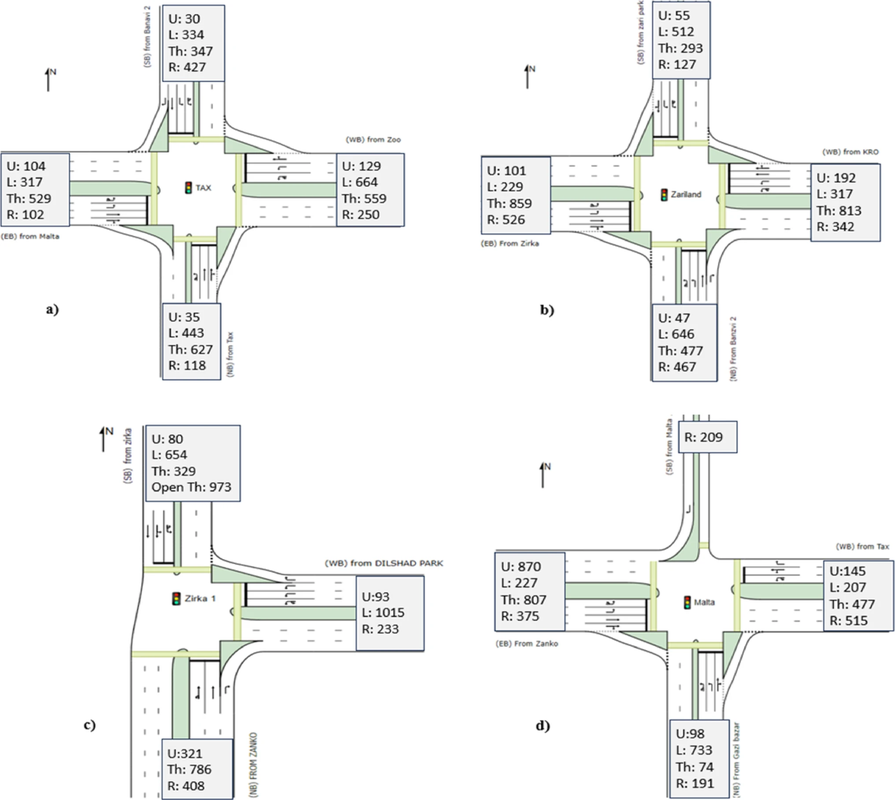
Analysis of existing conditions and optimization scenarios for signal control and enhanced geometric layouts at urban intersections represents a focus area in traffic engineering research. To assess four severely congested signalized intersections in Duhok/Iraq, a unified analytical framework was implemented to evaluate existing conditions, calibrate intersection models, and assess improvement scenarios. The aim was to extract transferable operational insights rather than demonstrate the use of a specific simulation tool.
Paired t-tests and Wilcoxon signed-rank tests were used to compare the model outputs against field observations, Highway Capacity Manual (HCM) estimates, and SIDRA outputs. Although no statistically significant differences were detected, substantial raw discrepancies in saturation-flow rates (mean absolute percentage errors exceeding 20%) justified site-specific calibration. The calibrated uncertainty parapmeters was handeled using sensitivity analysis by separately varying saturation flow, traffic demand, and green split and measuring their effects on delay and level of service (LOS). Validation was performed using four additional independent intersections not included in the calibration stage and based on movement-class-based multiplicative calibration factors.
Under existing conditions, analysis revealed severe operational inefficiencies (LOS F) at Zariland and Tax intersections, exhibiting average delay of 308.7 s/veh and 151.7 s/veh, respectively, while Malta and Zirka 1 intersections operate near capacity (LOS E). Optimization scenarios involving signal timing and geometric enhancements substantially dropped intersection delay and improved LOS from E to C. Nonetheless, 2039 projections, indicate a significant deterioration to LOS E–F, as anticipated traffic demand exceeds the designed capacity. These findings highlight the need for proactive strategies for congestion mitigation.